
Best Carpenter Ant Control Services in Phoenix AZ
Carpenter Ants (Camponotus) are common sights in America, Europe, and other parts of the world. Because Carpenter Ants cause damage to wooden areas where they nest, their presence can be mistaken for a Termite infestation. However, while Termites eat wood, Carpenter Ants merely make galleries in wooden areas for shelter.
All species of Carpenter Ants prefer decayed wood for their nesting sites, as these areas provide proper and consistent humidity and temperatures. Although Carpenter Ants do not eat wood, damage can be severe when nests remain active for several years. Over time, a Carpenter Ant colony can expand into several satellite colonies near the parent colony. Workers excavate wood for extra space, causing extensive damage to structures and woodwork.
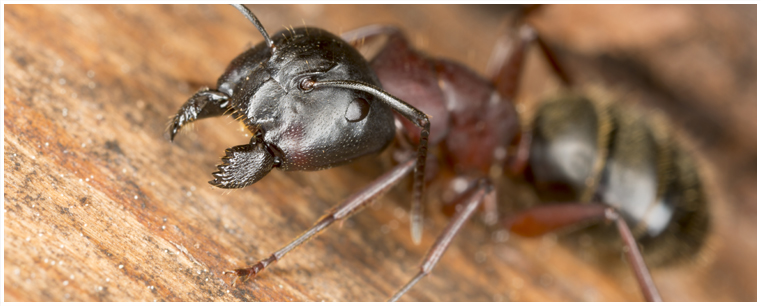
There are eighteen recorded species of Carpenter Ants in the U.S. alone. For this reason, Carpenter Ant identification can be difficult. Size and color of Carpenter Ants vary between species and even between individuals within one colony. Carpenter Ants measure between two to 20 millimeters in length and feature black, red, brown, yellow, orange, or red and black coloration. Although Carpenter Ants are among the largest Ant species worldwide, size is not a reliable factor in Carpenter Ant identification.
The most common winged Carpenter Ants have reddish brown thorax and heads, black abdomens and black bodies. Carpenter Ants are usually mistaken for termites, particularly during swarms when winged male and female Ants fly out of their colony to mate. The most important characteristics to look for when identifying a Carpenter Ant are elbowed antennae, a pinched or constricted waist, an evenly rounded thorax, and a single node between the thorax and abdomen.
Carpenter Ants develop by complete metamorphosis: from eggs to larvae, larvae to pupae, and pupae to adults. Adult Carpenter Ants have six legs, a constricted waist, three distinct body regions, and a ring of hairs at the tip of the abdomen. The color of eggs, larvae, and pupae varies depending on the species of Carpenter Ant.
Why be concerned about Carpenter Ants?
Carpenter Ants build two types of nests: parent colonies and satellite colonies. Parent colonies consist of a queen, her brood, and workers. Satellite colonies consist of thousands of workers. Workers create satellite colonies when the Carpenter Ant parent colony lacks sufficient space or when there is a suitable supply of food or water. Satellite colonies are typically located within 20 to 40 feet from the parent nest. There may be several satellite colonies associated with a parent colony.
If treated quickly, Carpenter Ants are seldom responsible for serious structural damage to houses and buildings. However, Carpenter Ants can cause extreme damage if they continue undiscovered for an extended period. Thus, it is best to contact a Pest Control professional in the event of an infestation.
Carpenter Ants do bite; however, they are not poisonous or do not carry disease. Worker Carpenter Ants inject formic acid into the skin causing pain. Most Carpenter Ant bites feel like a pinch and do not need treatment unless the skin is broken. If this occurs, wash the areas with soap and water, apply antibiotic ointment, and cover the wounds with a bandage.
Let a WATTS Pest Prevention technician handle this concern for you.
Identifying Carpenter Ant Infestations – signs of Carpenter Ant activity indoors include:
- Piles of wood debris or dead Carpenter Ants ejected from the colony
- “windows” or small openings to the nest
- Carpenter Ants foraging in kitchens, pantries, and other storage areas for food
- Swarmers
- Damaged timbers
Outdoors, in natural environments, Carpenter Ants dwell in both dead and living trees, stumps, and rotting logs—a few locations Carpenter Ants may be found.
Your WATTS Pest Prevention technicians are trained on both Carpenter Ant basics and the latest control techniques.
Preventing Carpenter Ant Recurrence:
Your WATTS Pest Prevention technician will be involved closely with you to educate you regarding Carpenter Ant Control, ensuring you are aware of what you must do to assist us with a successful plan. This will include tips that only you, as the homeowner, can ensure are completed. Some things your WATTS Pest Prevention technician will do as part of our Integrated Pest Management (IPM) plan.
Treating Carpenter Ant Infestations:
Because the size and color of Carpenter Ants vary between species and even between individuals within a single colony, these characteristics are not used in identifying Carpenter Ant infestation. Identification of Carpenter Ant species can only be made through careful observation of specific physical characteristics.
Carpenter Ant Control must be thorough and your cooperation enlisted.
A systematic and integrated process for achieving long-term, environmentally sound Carpenter Ant management must incorporate numerous chemical and non-chemical solutions to ensure that Carpenter Ant workers, eggs, larvae, and the queen are exterminated. Your WATTS Pest Prevention technician is licensed by the State of Arizona and has been specially trained in the safe use of all products necessary to take care of your Carpenter Ant Control problem. This combination of approaches is generally known as Integrated Pest Management (IPM) and is the approach used by WATTS Pest Prevention.

Pest Control products, if misused, can potentially poison or otherwise harm you, your children, or your pets.
PLEASE NOTE:Professional pesticides are only permitted for use by your licensed Pest Control professional! When their use is deemed necessary, WATTS Pest Prevention technicians follow stringent policies and procedures governing such use
PRODUCT SAFETY

We utilize an Integrated Pest Management (I.P.M.) approach for Arizona Pest Control. This comprehensive approach includes:
- Inspection - Service specialists conduct a thorough inspection of the property.
- Identification - Pests are identified for appropriate control measures.
- Environmental Modification - All possible environmental modification solutions are considered prior to any material application.
- Material Application - When a thorough inspection has been performed, a proper identification has been assessed, and all environmental modification options have been made (if applicable), a material application will be performed in a judicious, environmentally responsible manner.
OUR PROCESS

A successful Arizona Pest Control program requires more than simply relying solely on your recurring Pest Control services. Understanding that recurring Pest Control plays a critical role, supplemental Pest Control methods include the client’s cooperation in properly preparing and maintaining the property being serviced. Properly preparing and maintaining a Pest-free environment includes:
Interior Considerations: Seal holes in walls and around pipes, cables and wires. Seal cracks and crevices with paint or caulk. Seal other holes ¼” or larger. Fix leaky plumbing. Correct excessive moisture problems. Remove clutter. Organize storage rooms/closets. Store Pest nesting material (fabric, paper, rug scraps, plastic, and insulation) in Pest-proof containers. Clean and screen drains. Cap drains in basement floors. Store human and pet food in Pest-proof containers. Maintain excellent sanitation conditions. Dispose of Pest- or Rodent-infested goods. Remove fecal matter (rodents, bats, birds). Sanitize animal fecal matter after removal. Investigate secondary Pest potential from primary Pest infestation (e.g. fleas, mites).
Exterior Considerations: Cut vegetation back from building walls at least 18″. Remove ivy and other vines from sides of buildings or nearby trees. Trim back tree branches that touch or rub against building. Seal and/or repair air conditioning unit(s). Seal holes in walls and around pipes, cables, and wires. Seal other holes ¼” or larger. Repair damaged roof. Move compost into Pest-proof containers. Fix leaking irrigation. Eliminate standing water. Maintain properly functioning drains. Maintain order in storage shed(s) and/or garage(s). Store Pest nesting material (fabric, paper, rug scraps, plastic, and insulation) in Pest-proof containers. Store grass seed and pet food in Pest-proof containers. Remove debris, lumber and/or rock piles. Move firewood piles as far away from the structure as possible. Cut grass and eliminate weeds. Remove fallen fruit or nuts. Remove fecal matter (rodents, bats, birds). Sanitize animal fecal matter after removal. Investigate secondary Pest potential from primary Pest infestation (e.g. fleas, mites).
PREVENTION TIPS

Price Promise - At WATTS Pest Prevention, we are committed to operate in a financially sound manner, considering every cost incurred, in order to provide superior services at extremely reasonable rates to you, our customer.
Product Promise - WATTS Pest Prevention is committed to not only being environmentally responsible with the materials that we use, by utilizing technologically advanced measures such as I.P.M. (Integrated Pest Management) and low impact materials approved by the EPA (Environmental Protection Agency) and certified with the N.O.P. (National Organic Program), we also choose to conduct our day-to-day business operations with these same considerations toward being environmentally responsible.
Performance Promise - WATTS Pest Prevention is committed to providing a service experience that is not only exceptional and unmatched in our industry but also custom tailored to meet your specific needs. Did I mention that it boasts an amazing “Pest-Free, Or We’ll Waive The Fee” Guarantee! Simply stated, we have perfected our unique Pest Prevention process! WATTS Pest Prevention is a family owned and locally operated company. What this means to you is:
- Convenient, On-Time Service! Our service approach won’t ever leave you waiting on us!
- Professionally Dressed Technicians! Say goodbye to the average “bug guy!”
- Owner Investment & Involvement! I’m here when you need me!
- Careful Consideration To You & Your Property! We even wear shoe covers inside!
- Exceptional Service Experience! Every time!
- Availability! 24 Hours a day, 7 Days a week, our team is waiting for you…CALL NOW!
- Comprehensive Coverage! We offer the most comprehensive pest coverage this industry offers!
- Guaranteed Service Results! Ask about our “Pest-Free, Or We’ll Waive The Fee” Guarantee!
My PROMISE means your PROTECTION™!
Marc A. Watts Sr.
PRICE, PRODUCT AND PERFORMANCE PROMISE

If you select one of our eligible Pest Prevention Programs and observe any covered pest(s) in-between regularly scheduled service visits, or you were not completely satisfied with the last service we provided, Watts Pest Prevention will respond to correct the problem within forty-eight (48) hours*. If we fail to respond within forty-eight (48) hours, or fail to correct the problem, we will refund your last service charge. See Service Agreement for more details!
*Excluding weekends and holidays.
"PEST FREE, OR WE'LL WAIVE THE FEE" GUARANTEE